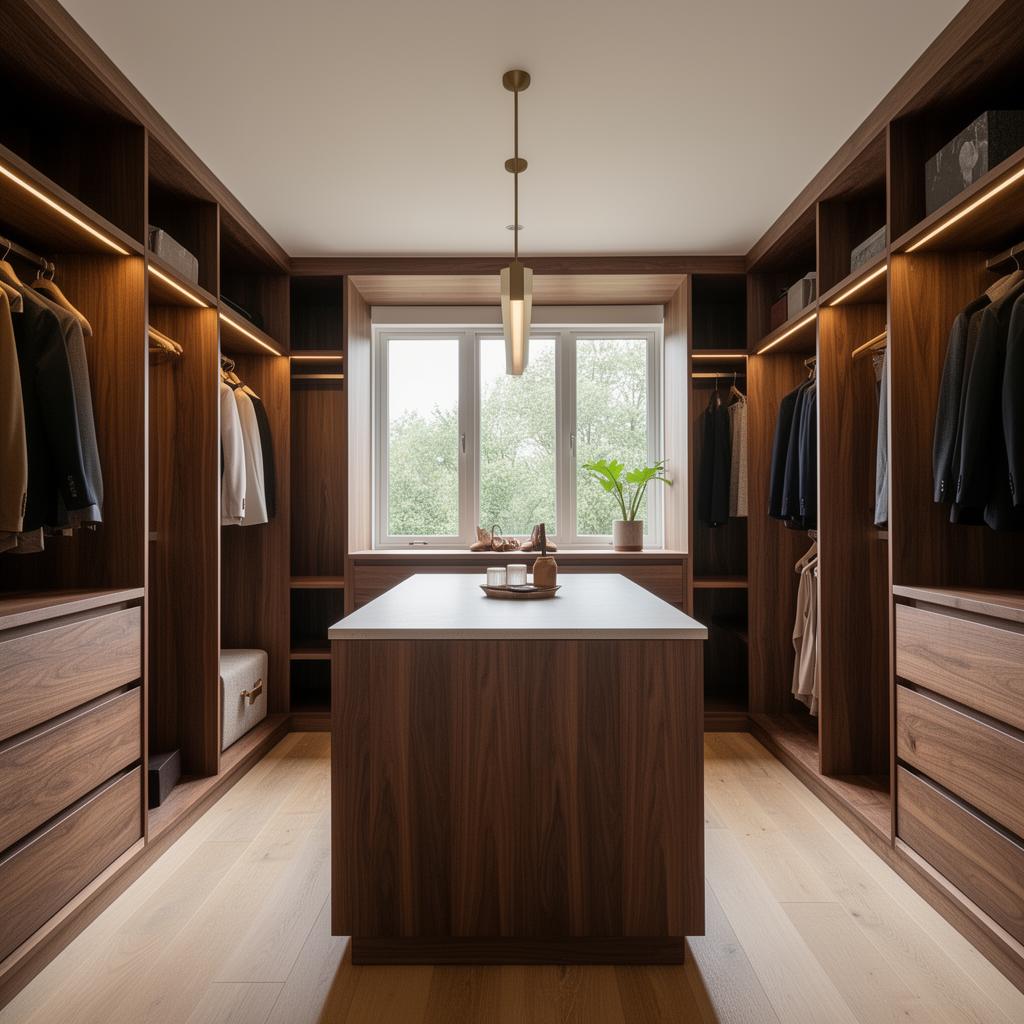
How much space do you need?
The realistic minimum for a usable walk-in is around 1.6 m wide by 2.0 m deep — enough for hanging on one side and a narrow walkway. A his-and-hers layout needs at least 2.2 m wide so two people can pass.
We routinely convert box rooms, loft conversions and the deeper end of a long master bedroom. If the space is too small for a traditional walk-in, an open joinery wall across one end of the bedroom often works as well.
Inside the wardrobe
Every walk-in is configured around how the owner actually dresses. We zone the space — full hang for dresses and coats, double hang for shirts and trousers, drawers for folded clothes, open shelves or pull-outs for shoes — and lay it out so the items used most often sit at eye level.
- Full-height and double-height hanging rails
- Soft-close drawer banks with glass tops for visibility
- Pull-out trouser rails, tie racks and valet rods
- Open shoe shelves or angled shoe walls
- Integrated LED strip lighting on motion sensors
Lighting and ventilation
Good lighting is the difference between a walk-in that feels luxurious and one that feels like a cupboard. We integrate warm-white LED strips under every shelf and along the top of every hanging rail, wired to motion sensors so they come on as you walk in.
Frequently asked questions
- Do I need doors on a walk-in wardrobe?
- No. The open style is part of the appeal — it's faster to use, looks more luxurious, and lets the lighting work. If you need to hide clothes from view, a single sliding or pocket door at the entrance is enough.
- Can a walk-in fit under a loft slope?
- Yes — angled wardrobes are one of our specialities. We follow the rafter line, run hanging where the headroom allows, and use the low ends for drawers and shoe storage.
Ready to start your project?
Book a £150 home survey and we'll measure, sample and quote — fully deductible from your order. Or design your wardrobes online in the configurator first.