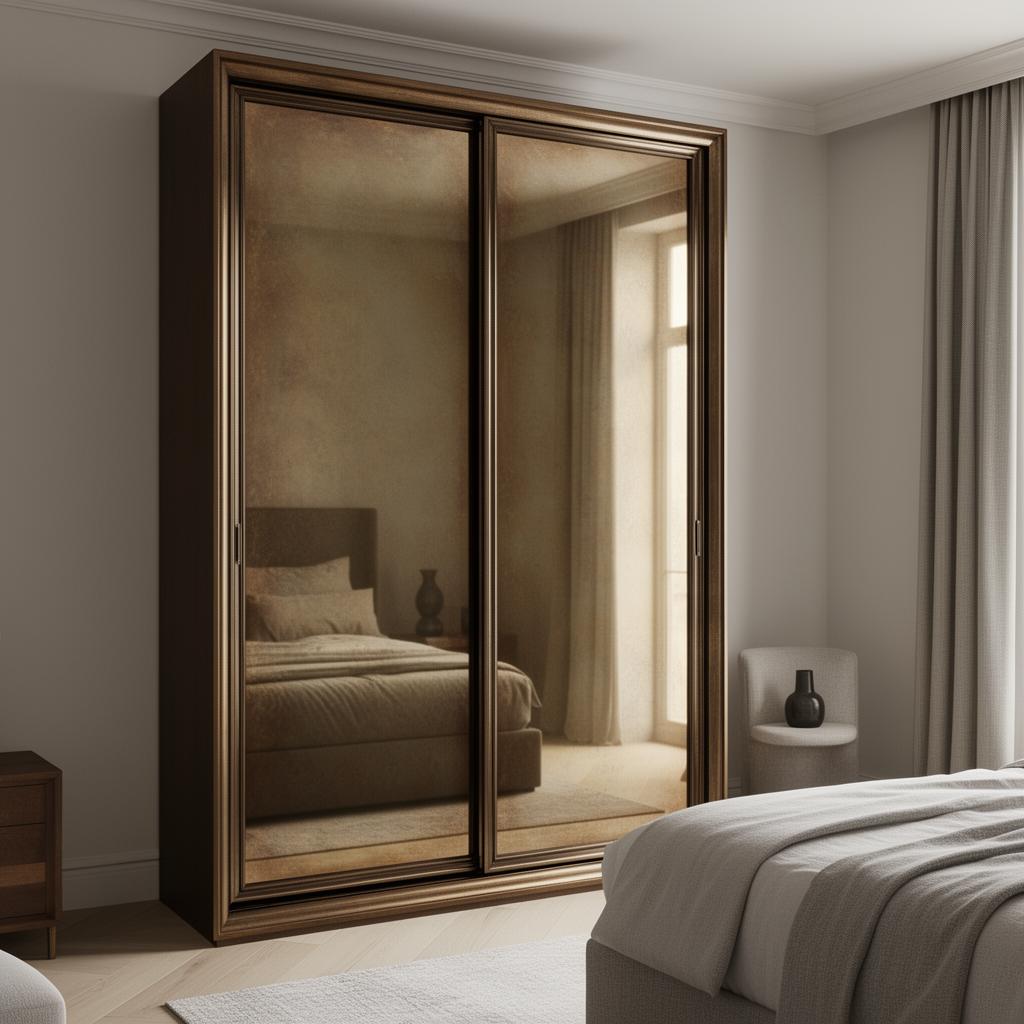
When sliding wardrobes are the right choice
Sliding doors are the obvious answer where floor space is tight. A hinged door needs 50–60 cm of clearance in front of it; a sliding door needs none. That makes them ideal for box rooms, narrow Victorian back bedrooms, and any room where the wardrobe wall faces a bed or desk.
They also work better than hinged doors across wide runs. A four-metre wall in hinged doors becomes a stack of small panels; in sliding doors it becomes two or three large planes of mirror, glass or laminate that read as a single feature wall.
Door finishes
All SAV sliding wardrobes use full-height door panels in your choice of finish — mirror, glass or laminate.
- Mirror — plain silver, bronze-tinted or grey-tinted, with slim aluminium frames
- Glass — frosted or clear tempered, behind a coloured backing panel for depth
- Laminate — plain colour or wood-grain, matched to the rest of the joinery
Tracks and hardware
We specify top-hung tracks with soft-close mechanisms on both opening and closing — no slammed doors, no risk of pinched fingers. Bottom guides are floor-recessed where the subfloor allows so there is no raised threshold to trip over.
Frequently asked questions
- Do sliding doors look more contemporary than hinged?
- Generally yes — sliding doors read as large planes rather than panelled joinery, which suits modern flats and renovated period rooms with a contemporary interior.
- Can I have shaker-style panels on sliding doors?
- Panelled detail isn't available on sliding doors. For a shaker look choose hinged doors instead.
- How heavy can a sliding door be?
- Our tracks comfortably carry mirror or glass doors up to 120 kg and 2.6 m tall — covering almost any London ceiling height.
Ready to start your project?
Book a £150 home survey and we'll measure, sample and quote — fully deductible from your order. Or design your wardrobes online in the configurator first.