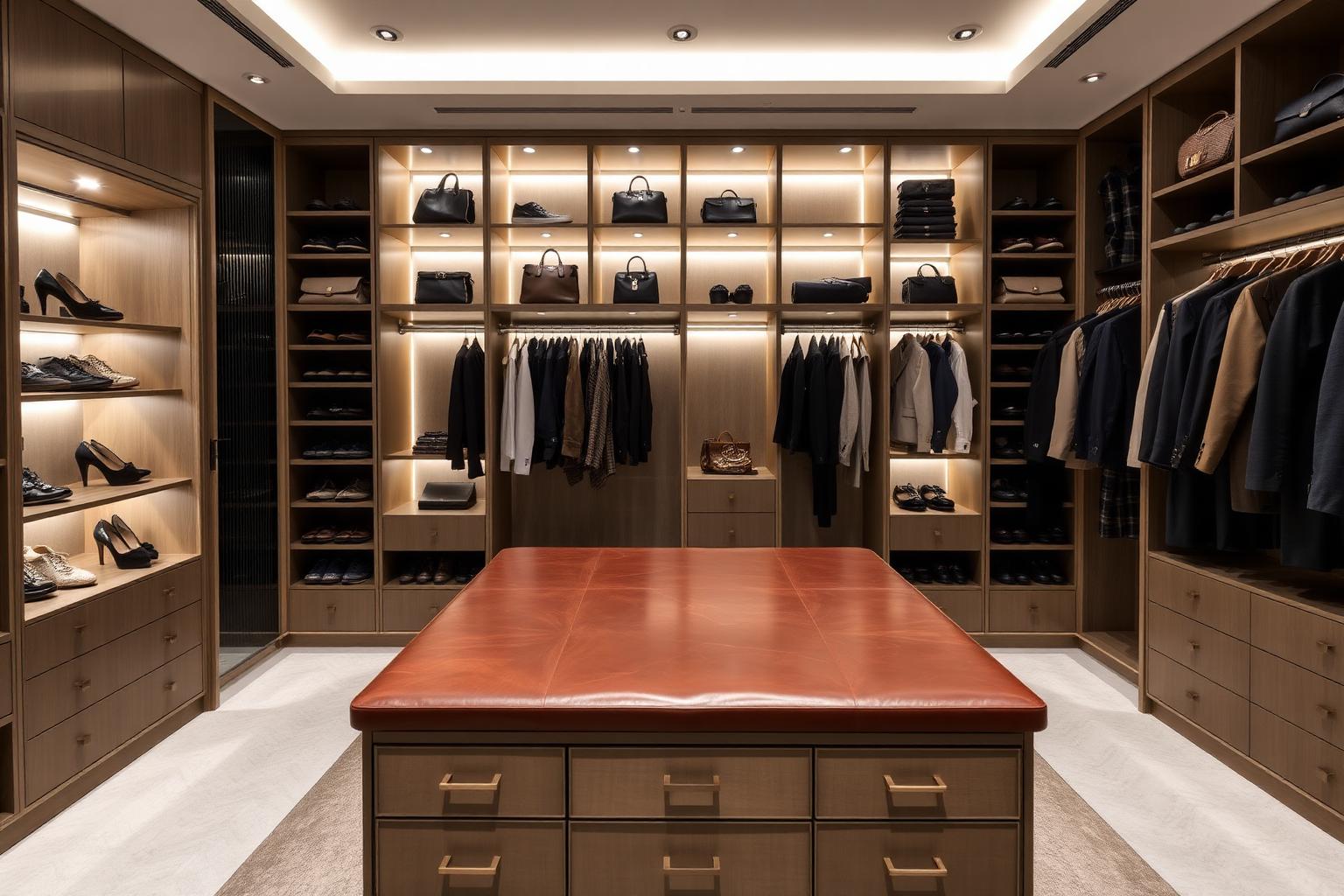
The doors get all the attention in fitted wardrobes, but the interior is what you live with every morning. A beautifully laminate Shaker front is no help at all if there's only one shelf and one rail behind it. Here's how we think about specifying the inside of a wardrobe.
Full hanging vs double hanging — what's right for your wardrobe?
Hanging space is the single most important variable. There are three standard configurations:
- Full hanging (long) — single rail at roughly 1700–1850mm AFFL, clear drop of 1500–1700mm below. Required for dresses, long coats, long skirts, jumpsuits.
- Double hanging — two rails, typically at 1050mm and 2050mm AFFL. Doubles the capacity on the same wall length. Works for shirts, blouses, folded trousers, jackets — anything under about 90cm long.
- Short hanging over drawers — single rail at around 1100mm AFFL with a bank of three or four drawers below. The classic "his side" configuration.
As a rough split for most London couples: 30–40% full hanging, 40–50% double hanging, with the remainder split between drawers, shelves and shoe storage. Count what you actually own before designing — wardrobes are routinely under- or over-spec'd because clients estimate rather than measure.
Drawer configurations and heights
A drawer bank inside a wardrobe is usually 4–6 drawers tall. Heights matter — get them wrong and the drawer is either half-empty or impossible to close:
- 80–100mm internal — jewellery, watches, ties, belts, sunglasses. Often with a felt or leather insert tray.
- 120–140mm internal — underwear, socks, swimwear.
- 180–200mm internal — t-shirts, light knitwear, folded shirts.
- 220–260mm internal — heavy knitwear, folded denim, sweatshirts.
Always spec soft-close metal runners (Blum Tandem or equivalent) rather than basic ball-bearing runners — the difference in feel is enormous and the lifespan is decades rather than years. For premium jobs we'll add solid timber drawer boxes with finger-jointed corners and leather-lined bases, but for most clients a high-quality engineered drawer with a wipeable insert is the sensible choice.
Shoe storage — racks, pull-outs and angled shelves
Shoes are the interior fitting that clients most often forget at design stage and most often regret leaving out. Three main options:
- Angled open shelves — fixed shelves at roughly 10° tilt with a low front lip. Pairs of shoes face out so you can see them at a glance. Best for showing off a collection in a walk-in or behind glazed doors.
- Flat shelves with a fence — adjustable flat shelves with a 20mm timber or brass fence to stop shoes sliding off. Most flexible — adjust the heights as the collection changes.
- Pull-out shoe racks — wire or timber racks on full-extension runners. Best for narrow tower units; you can pull the whole rack out to see every pair without bending.
Allow roughly 200mm vertical per pair of women's flats or men's trainers, 250mm for low boots, and 350–400mm for tall boots (or store those upright on the floor with cedar shapers). A typical 600mm-wide shoe section will hold around 12–16 pairs depending on style.
How to use our online configurator to spec your interior
Our configurator lets you sketch out a wardrobe and assign each section an interior type — long hanging, double hanging, drawers, shelves, shoes, accessories — and see the price update live. It's not a substitute for a survey, but it gets you to a credible budget and design in about 15 minutes.
A typical first pass looks something like this: open the configurator, enter the wall dimensions, drop in a single full-width wardrobe, then divide it into 800mm sections. Assign two sections to double hanging (his/hers shirts), one to full hanging (her dresses, his suits), one to a drawer bank, and one to a shoe tower with pull-out racks. Choose door style and colour. Submit the design when you book your survey, and your surveyor will use it as the starting point on the day rather than asking you to begin from scratch.
Other interior options we offer that don't show on the standard configurator — leather-lined drawer bases, pull-out trouser rails, motorised hanging rails, integrated jewellery trays, back-lit display shelving, PIR-activated LEDs — can all be added at survey stage with a clear cost on the quote.
Ready to spec your interior?
Try the configurator to get a credible first design and budget, then book a survey to refine it with our team.