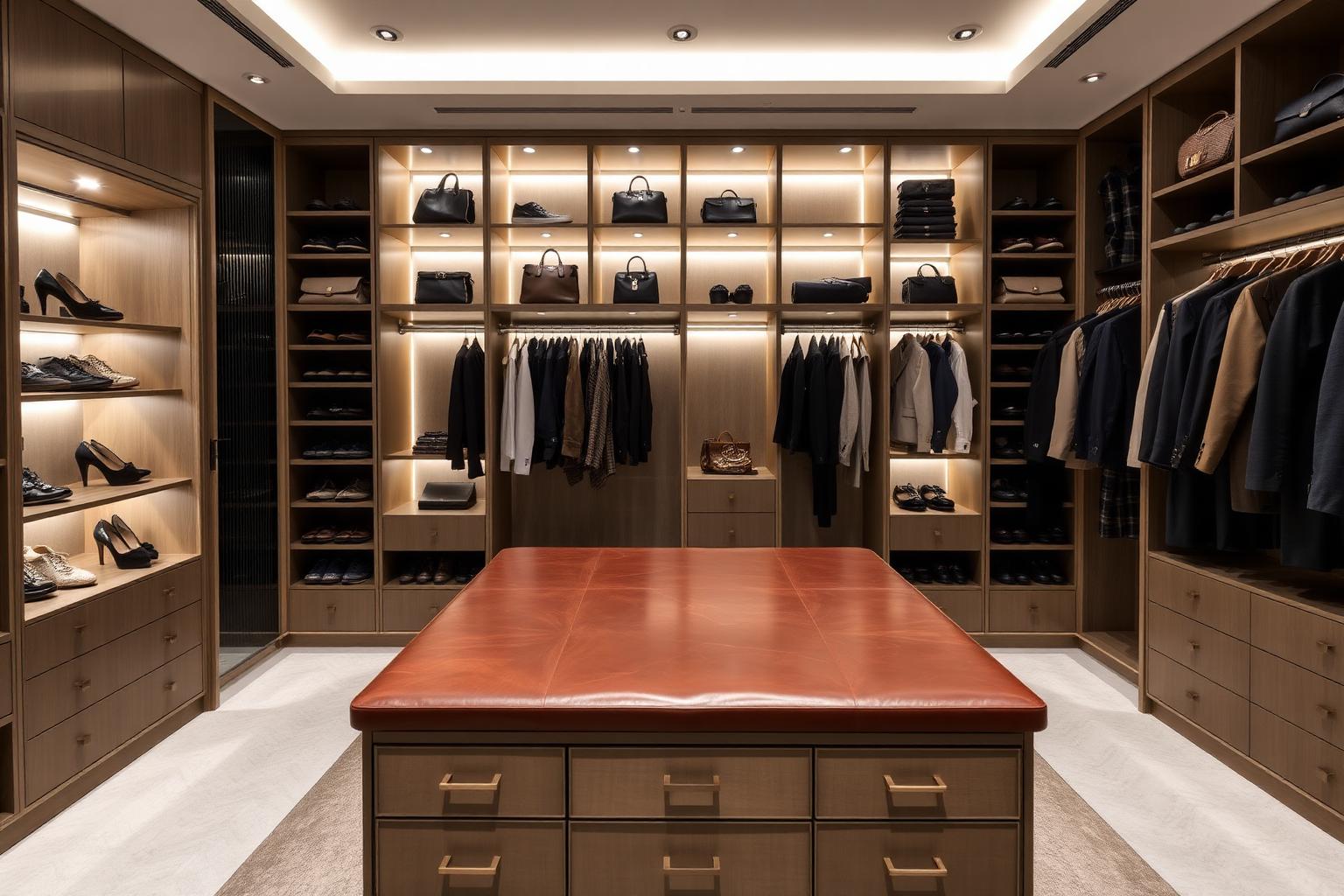
A walk-in wardrobe is, more than anything, a planning exercise. Get the dimensions and zoning right at the survey stage and the room more or less designs itself. Get them wrong and even the most expensive joinery feels cramped. Here's how we approach it on London projects.
How much space do you actually need for a walk-in wardrobe?
The honest minimum for a workable walk-in is around 2.4m² of clear floor area, with at least one wall length of 1.8m. Below that you're really designing a deep reach-in wardrobe rather than a true walk-in. Comfortable working dimensions look like this:
- Single-sided walk-in (hanging on one wall): minimum 1.4m wide × 2.0m long. 600mm carcass depth + 800mm clear walkway.
- Double-sided walk-in (hanging on both walls): minimum 2.0m wide × 2.0m long. 600mm + 600mm carcasses + 800mm walkway between.
- U-shaped walk-in (storage on three walls): minimum 2.4m wide × 2.4m long to allow turning room.
- Walk-in with central island: minimum 3.0m wide × 3.0m long. The island itself needs 900mm clear all the way around for comfortable use.
A 2.4m ceiling gives you room for a proper top-box; anything under 2.2m and the design gets tight.
Zoning your dressing room — hanging, folding and accessories
The single biggest mistake we see in DIY walk-ins is treating every section the same. Different garments need different vertical space. As a working rule:
- Long hanging (dresses, coats, long skirts): 1500–1700mm clear vertical space.
- Short hanging (shirts, blouses, folded trousers): 900–1100mm — allowing a second rail below or a drawer bank.
- Double hanging: two rails at roughly 1050mm and 2050mm AFFL. Doubles capacity on the same wall length.
- Drawer banks: typically 4–6 drawers, depths 100mm (jewellery/accessories) through to 250mm (knitwear, denim).
- Open shelving: 320–380mm clear for folded jumpers, taller for handbags.
Plan his and hers (or wearer A / wearer B) zones rather than mixing categories. It keeps daily routines fast and the room calm.
Lighting a walk-in wardrobe properly
Lighting in a walk-in is what separates a real dressing room from a glorified cupboard. We typically spec three layers:
- Ambient ceiling lighting: warm white (2700K) downlights or a single statement pendant in larger rooms. Avoid cool white — it makes skin tones unreliable when dressing.
- Task lighting inside the joinery: PIR-activated LED strips under each shelf and above hanging rails. Light comes on automatically when doors open.
- Mirror lighting: a full-length mirror with concealed back-lit LEDs or a pair of wall lights either side, again warm-white.
On premium jobs we'll integrate the whole scheme into a Lutron or similar control system so the room steps through morning, evening and "putting laundry away" scenes at the press of a single button.
Walk-in wardrobe interior layouts — what we recommend
Three layouts cover most of our London walk-in projects:
- Galley — storage on two facing walls, end wall left for a full-length mirror. Best for long, narrow rooms.
- U-shape — storage on three walls, entrance on the fourth. Maximum perimeter storage; works in square rooms.
- Island — perimeter storage plus a central island with drawers and a leather or stone top. Needs a minimum 3.0m × 3.0m room.
A typical internal split for a couple is around 60% hanging (mixed long and double), 25% drawers, and 15% shelves and shoe storage. Adjust to suit your actual wardrobe — count your hanging garments before designing.
Converting a spare London bedroom into a dressing room
Most of our London walk-in projects start with a spare second bedroom — typically the smallest bedroom of a Victorian or Edwardian terrace, often 8–11m². The maths usually favours conversion: a properly-fitted dressing room frees the master of all storage furniture, makes both rooms calmer, and tends to add more value at sale than the spare bedroom does (provided you're not dropping below a three-bedroom count).
Practical considerations: keep the doorway and the window untouched so the room can revert to a bedroom in future, run all electrics in surface-mounted or ceiling-fixed routes rather than chasing walls, and avoid load-bearing reconfiguration. The chimney breast in a Victorian back bedroom usually makes a perfect natural divider between a hanging zone and a dressing zone.
Planning a walk-in for your London home?
Book a £150 home survey and we'll measure, sketch layout options on the day, and produce a fixed-price design. The fee is deducted from your order.