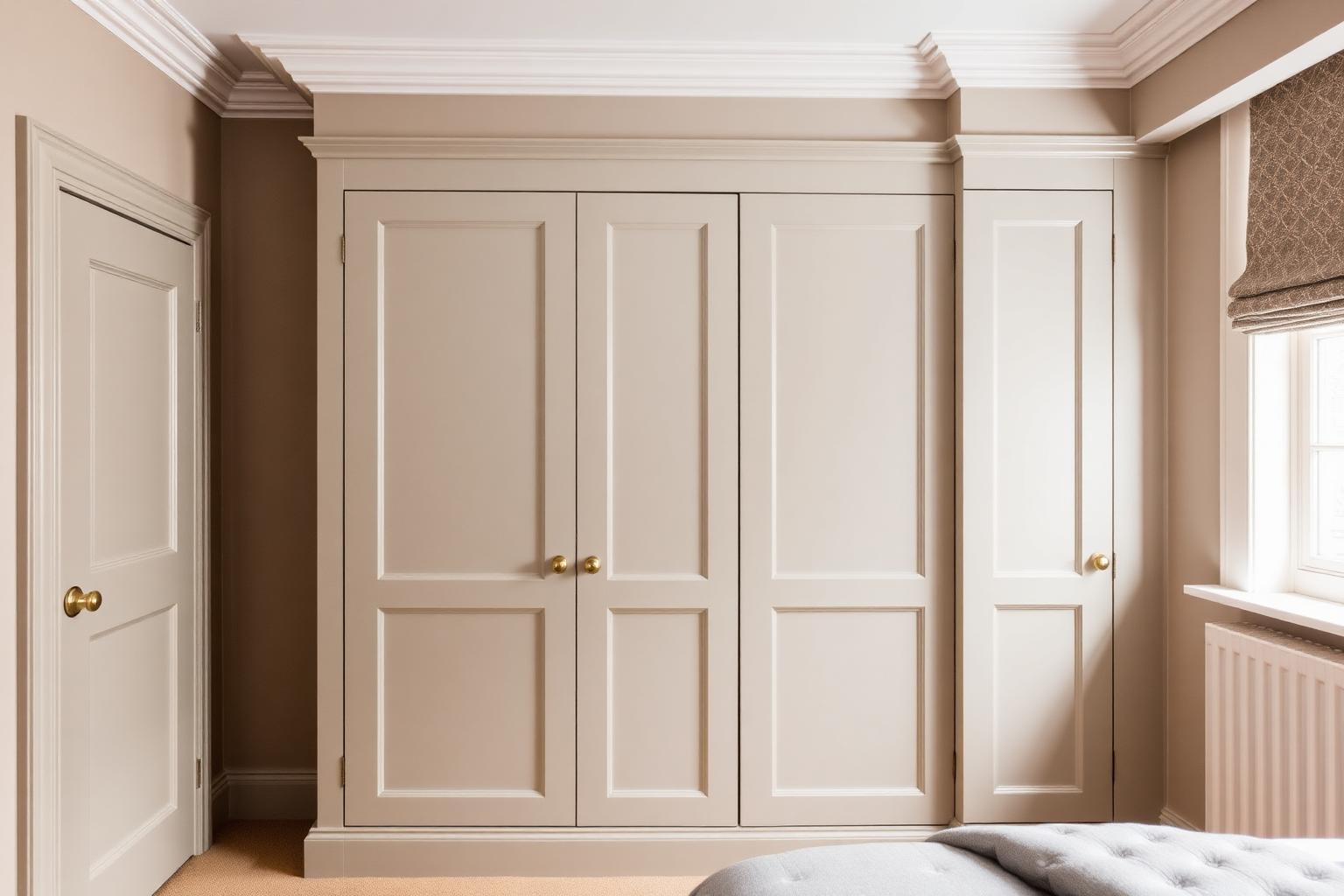
Almost every client we meet has at some point stood in their bedroom weighing up the same question: order another flat-pack wardrobe or commit to bespoke joinery. The right answer depends on the room, how long you plan to stay, and how much storage you genuinely need. Below is what we tell people in surveys.
The case for fitted wardrobes in a London home
London bedrooms rarely come in straightforward rectangles. Chimney breasts, alcoves of different depths, picture rails, awkward window placement and sloping loft ceilings all conspire against off-the-shelf furniture. Fitted wardrobes are built specifically for the room they live in, scribed to skirting and cornice, and use every cubic inch from floor to ceiling and wall to wall.
Floor-to-ceiling storage in small rooms
A standard freestanding wardrobe is roughly 2m tall and stands on legs, which leaves a dead zone above and a hard-to-clean strip underneath. In a 9m² London second bedroom that adds up to around half a cubic metre of wasted storage. A floor-to-ceiling fitted run on the same wall gives you a full-height hanging section, a top-box for suitcases and seasonal kit, and drawers at the bottom — typically 40–60% more usable storage in the same footprint.
Adds value to your property
London estate agents consistently list "fitted storage" as a feature in marketing copy because buyers price it in. Well-executed bespoke joinery typically returns more than its cost at sale — particularly in period properties, where buyers expect alcoves to be properly used. By contrast, freestanding wardrobes leave with you, and second-hand flat-pack rarely sells for anything meaningful.
When freestanding might be the right call
Bespoke isn't always the answer. If you're renting, planning to move within 12–18 months, or furnishing a guest room you rarely use, the case for a £4,000–£6,000 fitted wardrobe is weaker. A good freestanding piece — a real timber armoire, a vintage French wardrobe, or a higher-end IKEA PAX with custom doors from a third party — can work well and travel with you. Freestanding also makes sense in listed buildings or rentals where you can't scribe joinery into the fabric of the room.
One honest caveat: most clients who tell us "we're only here another year or two" are still in the same flat five years later. If you suspect that's you, the bespoke maths gets much better.
IKEA PAX vs bespoke fitted — real cost comparison
Take a typical London master bedroom with a 3m wall to fill. Here's how the numbers usually break down at 2026 prices:
| Option | Typical cost (3m wall) | Lifespan |
|---|---|---|
| IKEA PAX, stock doors, self-assembled | £900–£1,400 | 5–8 years |
| IKEA PAX with custom doors + assembly | £2,200–£3,500 | 8–12 years |
| Bespoke fitted, laminate-faced MDF Shaker | £4,200–£6,800 | 25+ years |
| Bespoke fitted, premium veneer or laminate-finished | £6,500–£9,500 | 25+ years |
Spread over a realistic lifespan, bespoke usually works out at roughly the same cost per year as a high-spec PAX install — with significantly more usable storage, a finish that matches the property, and no awkward gaps top, bottom or sides.
Our verdict for most London bedrooms
For owner-occupied homes you plan to live in for more than three years, bespoke fitted wardrobes are almost always the better long-term decision. They make small London bedrooms feel calmer, properly resolve period quirks, and stand up over decades. For short-term, rental, or genuinely temporary scenarios, a well-chosen freestanding piece or a customised PAX is the sensible call.
Thinking about fitted wardrobes for your London home?
Book a £150 home survey and we'll measure your room, bring samples, and produce a fixed-price design. The fee is deducted from your order.